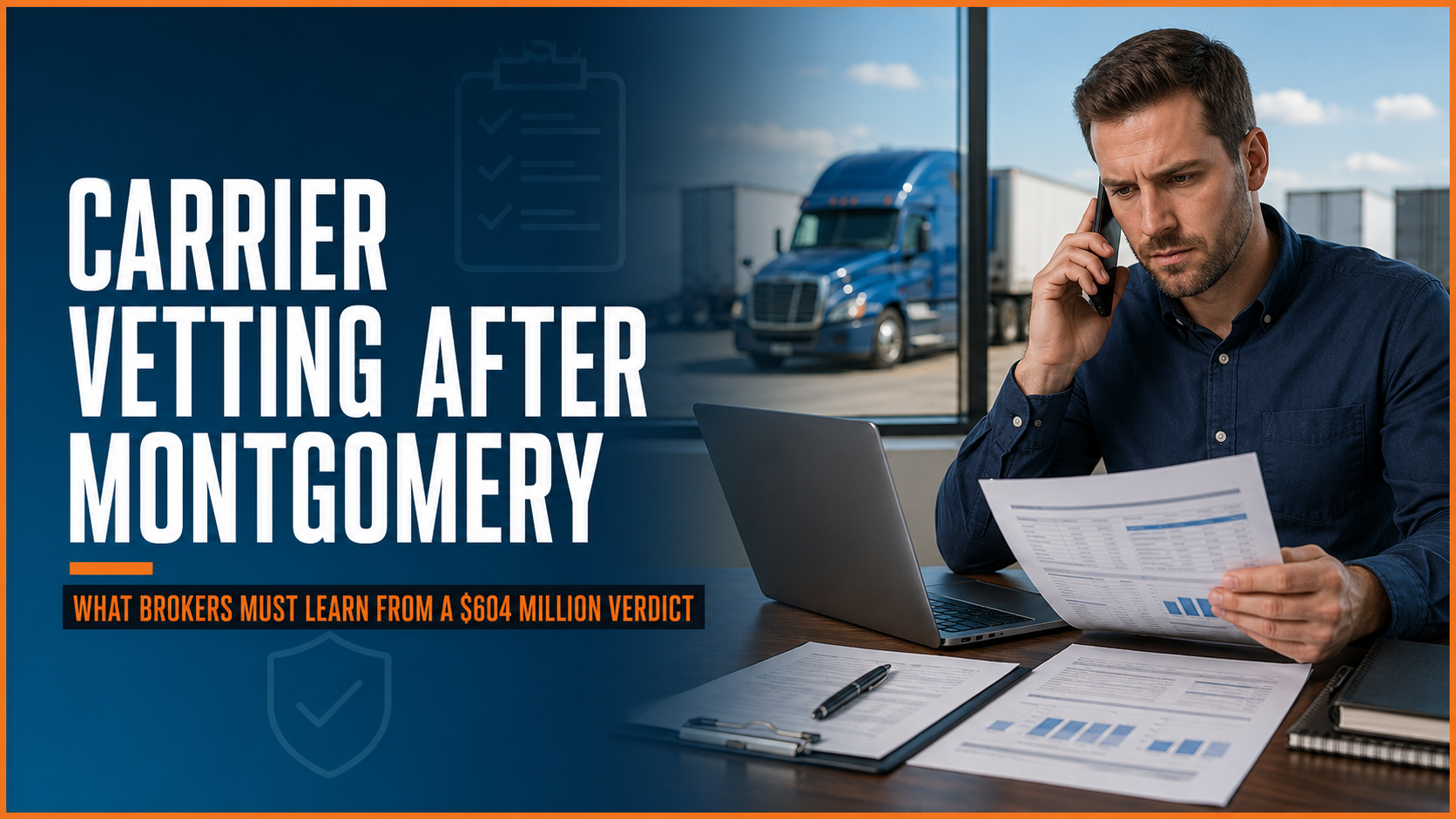
A satisfactory FMCSA rating may no longer be enough to defend a broker’s carrier-selection process after a serious crash.
For freight brokers, selecting a motor carrier has always involved balancing capacity, cost, service and safety.
In the post-Montgomery legal environment, however, carrier selection can also expose a broker to direct negligence claims and potentially enormous verdicts.
That risk became much more tangible on July 23, 2026, when a Dallas County jury returned an approximately $604 million verdict involving C.H. Robinson, motor carrier Lupus Superior and the carrier’s driver.
The case arose from a March 2021 crash on Interstate 20 near Jackson, Mississippi. A Lupus Superior tractor-trailer struck stopped traffic, causing a six-vehicle pileup that killed three motorists and injured others. The truck driver was also killed.
C.H. Robinson had selected Lupus Superior to transport products for Arizona Beverages. According to reporting from FreightWaves, the jury assigned 45% of the fault to the driver, 32% to Lupus Superior and 23% to C.H. Robinson.
C.H. Robinson has stated that it did not act negligently and intends to appeal. The company emphasized that Lupus Superior had completed nearly 270 loads for its customers and held a Satisfactory FMCSA safety rating when selected.
The verdict is therefore not necessarily the final outcome of the case. Nevertheless, it sends brokers an urgent message: Active operating authority and a Satisfactory FMCSA rating may not, by themselves, demonstrate that a broker exercised reasonable care when selecting a carrier.
Here’s what you need to know.
What Did the Supreme Court Decide in Montgomery v. Caribe Transport II?
The C.H. Robinson verdict came approximately two months after the U.S. Supreme Court issued its unanimous decision in Montgomery v. Caribe Transport II, LLC.
That case also involved C.H. Robinson and a motor carrier it had selected. The injured plaintiff alleged that C.H. Robinson negligently hired a carrier that had a Conditional FMCSA safety rating and documented deficiencies involving drivers, hours of service, maintenance and crashes.
Historically, brokers frequently argued that negligent-selection claims were preempted by the Federal Aviation Administration Authorization Act, commonly known as the FAAAA. The law generally restricts states from enforcing laws related to a broker’s prices, routes or services.
On May 14, 2026, the Supreme Court ruled that negligent-hiring claims involving motor vehicle safety fall within the FAAAA’s safety exception. As a result, the FAAAA does not automatically prevent an injured person from bringing a state-law negligent-selection claim against a freight broker.
The Court explained that requiring a broker to use ordinary care when selecting a carrier concerns the trucks that will transport the freight and therefore concerns motor vehicle safety. The full decision is available through the U.S. Supreme Court.
The decision does not mean that a broker is automatically liable whenever one of its contracted carriers causes a crash. A plaintiff must still prove the elements of the applicable state-law claim.
What Montgomery does mean is that brokers may no longer be able to end these lawsuits simply by raising FAAAA preemption. Courts and juries can now examine what the broker knew, what information was reasonably available and how the carrier-selection decision was made.
Why the C.H. Robinson Verdict Matters
The C.H. Robinson case highlights two different but related risks for brokers.
1. Negligent carrier selection
Plaintiffs may argue that a broker knew or should have known that a carrier presented an unreasonable safety risk.
This claim could be based on information such as:
- A Conditional or Unsatisfactory safety rating
- An out-of-service order
- Repeated unsafe-driving violations
- High driver or vehicle out-of-service rates
- Hours-of-service problems
- Maintenance violations
- A concerning crash history
- Insurance problems
- Prior incidents involving the broker’s freight
- Internal complaints or documented safety concerns
- Warning signs that were identified but ignored
- Exceptions made to the broker’s normal qualification standards
The question may no longer be limited to whether the carrier was legally authorized to operate. The broker could be asked to explain why the carrier was considered an acceptable choice based on all reasonably available information.
2. Control over the carrier or driver
The jury was also asked whether the Lupus Superior driver was performing a mission for C.H. Robinson’s benefit while being subject to the broker’s control over the details of that mission.
According to FreightWaves, the jury answered that question in a manner that supported holding C.H. Robinson responsible. That finding will likely be a major focus of the appeal.
If this part of the verdict survives appellate review, brokers could face additional exposure when their actual operations suggest that they are controlling the carrier or driver, not merely arranging transportation.
Independent-contractor language in a broker-carrier agreement remains important, but the parties’ real-world conduct can matter just as much. A broker that directs the driver’s route, schedule, operating methods, rest periods or other day-to-day details may create arguments that it exercised control beyond the traditional role of a broker.
Brokers should work with transportation counsel to define operational boundaries while maintaining clear procedures for responding to immediate safety concerns.
Why a Satisfactory FMCSA Rating May Not Be a Complete Defense
A Satisfactory safety rating is still an important piece of information. FMCSA defines it as a finding that a carrier had adequate safety-management controls at the time of a rated investigation.
However, a safety rating is not a real-time certification that every driver, vehicle or future load will operate safely.
FMCSA explains that safety ratings are generally assigned following a rated investigation or compliance review. It also recognizes four possible carrier statuses:
- Satisfactory: Adequate safety-management controls were found.
- Conditional: Adequate controls were not in place to ensure compliance.
- Unsatisfactory: Inadequate controls resulted in serious safety deficiencies.
- Unrated: FMCSA has not assigned the carrier a safety rating.
An Unrated carrier is not automatically unsafe, just as a Satisfactory carrier is not automatically free from current risk.
FMCSA also warns users not to draw conclusions about a carrier’s overall safety condition solely from Safety Measurement System data. SMS is an enforcement-prioritization tool, not a replacement for a formal safety rating.
That warning cuts both ways. A broker should not automatically label a carrier unsafe based on one data point, but it should also avoid treating a single favorable label as the entire vetting process.
The safer approach is to use consistent, documented criteria that consider the carrier’s complete risk profile.
10 Carrier-Vetting Practices Brokers Should Implement
There is no single checklist that can eliminate every accident or lawsuit. The following practices can help brokers create a more consistent and defensible carrier-selection program.
1. Verify the carrier’s identity
Confirm that the company presenting itself as the carrier matches FMCSA and insurance records.
Review:
- Legal business name
- DBA names
- USDOT number
- MC number
- Physical address
- Telephone number
- Email domain
- Tax identification information
- Insurance documentation
- Equipment ownership or leasing information when appropriate
Identity verification is increasingly important because of carrier impersonation, double brokering, stolen identities and unauthorized load re-brokering.
2. Confirm active operating authority
Verify that the carrier has the correct active authority for the transportation being arranged. The broker should also look for pending revocations, out-of-service orders or other restrictions.
Do not rely exclusively on a certificate or screenshot supplied by the carrier. Check current information through FMCSA’s official systems.
3. Verify insurance independently
Confirm coverage with the insurer or authorized insurance representative rather than relying only on a certificate supplied by the carrier.
Review:
- Policy status
- Effective and expiration dates
- Liability limits
- Cargo coverage
- Required endorsements
- Exclusions relevant to the load
- Insurer identity and financial strength
- Whether the insured name matches the operating carrier
The broker should also have a system for receiving and responding to insurance cancellations or policy changes.
4. Review the FMCSA Company Snapshot
FMCSA’s SAFER Company Snapshot provides a carrier’s identification, fleet information, operating status, safety rating, inspection results and crash data.
At minimum, the broker should review:
- Safety rating
- Operating status
- Out-of-service status
- Inspection volume
- Driver out-of-service rate
- Vehicle out-of-service rate
- Reported crashes
- Fleet size
- Mileage
- Cargo classifications
- Date of the most recent MCS-150 update
A mismatch between the carrier’s stated operation and its FMCSA profile should be investigated before tendering a load.
5. Look for safety trends, not just one number
A carrier’s history should be evaluated in context. A single violation may not establish that a carrier is unsafe, especially when the carrier has significant inspection exposure. Repeated violations in the same safety category, however, may indicate weak safety-management controls.
Pay particular attention to patterns involving:
- Speeding and reckless driving
- Hours-of-service compliance
- Driver fitness
- Vehicle maintenance
- Brake, tire and lighting violations
- Controlled substances or alcohol
- Mobile-phone use
- Out-of-service violations
- Preventable crashes
- Failure to obey out-of-service requirements
Document how the carrier’s size, inspection exposure and operating history were considered.
6. Establish risk-based qualification standards
Not every load carries the same exposure. A carrier hauling routine dry freight may not require the same review as one transporting hazardous materials, oversized equipment, high-value cargo or passengers.
A risk-based program may include:
- Standard qualification criteria for all carriers
- Additional requirements for higher-risk commodities
- Stricter insurance limits for certain loads
- Minimum experience requirements
- Additional review for new entrants
- Escalation procedures for Conditional or Unrated carriers
- Senior approval for exceptions
- Legal or insurance review for unusually high-risk movements
The standards should be written, consistently applied and periodically reviewed.
7. Investigate known warning signs
The post-Montgomery question is likely to be: What did the broker know, and what should it reasonably have known?
A broker should investigate credible safety warnings rather than processing the load as usual.
Potential warning signs include:
- A driver reporting illness or fatigue
- A carrier requesting an unrealistic delivery schedule
- Evidence of hours-of-service pressure
- An expired insurance certificate
- A recent authority change
- A serious crash
- A sudden increase in violations
- A complaint from a customer, driver or member of the public
- A carrier attempting to substitute another company or driver
- Information suggesting the load has been re-brokered
The broker should document the warning, the investigation and the final decision.
8. Create an immediate safety-escalation process
If a broker learns that a driver is sick, fatigued, impaired or operating unsafe equipment, the issue should be escalated immediately.
Delivery expectations should never take priority over highway safety. Employees need clear authority to pause a shipment, contact the carrier’s safety department or arrange another solution without being penalized for delaying the load.
At the same time, brokers should work with counsel to distinguish safety escalation from controlling the driver’s daily work. The motor carrier should remain responsible for:
- Selecting and dispatching drivers
- Qualifying drivers
- Monitoring hours of service
- Choosing routes
- Inspecting and maintaining equipment
- Managing rest and duty status
- Supervising driver performance
9. Document the selection decision
A broker may make a reasonable decision and still have difficulty defending it if there is no record of what was reviewed.
The carrier file should identify:
- When the carrier was approved
- Which databases were checked
- What information was reviewed
- Who completed the review
- Whether any concerns were identified
- How those concerns were resolved
- Who approved any exception
- When the carrier was last requalified
- What information was available on the date of each load assignment
An unexplained “approved” status is far less useful than a documented decision supported by defined standards.
10. Monitor carriers continuously
Carrier vetting should not be a one-time onboarding event.
Authority, insurance, safety data, ownership, contact information and operating practices can change. A carrier that qualified last year—or even last month—may no longer meet the broker’s requirements.
Monitoring should occur:
- Before initial approval
- Before or at load assignment
- When insurance or authority changes
- After a serious crash or safety complaint
- When new enforcement information appears
- At established requalification intervals
Automated monitoring can help identify changes, but alerts still require trained people, escalation rules and documented decisions.
Carrier-Vetting Mistakes Brokers Should Avoid
In the post-Montgomery environment, several common practices may be difficult to defend:
- Approving every carrier with active authority
- Treating a Satisfactory rating as permanent proof of safety
- Assuming an Unrated carrier has passed a federal safety review
- Ignoring inspection and violation trends
- Allowing sales or capacity pressure to override safety standards
- Making undocumented exceptions for favored carriers
- Failing to investigate complaints or safety warnings
- Relying exclusively on carrier-supplied insurance documents
- Continuing a load after learning the driver may be sick or fatigued
- Directing the driver’s day-to-day work as though the driver were the broker’s employee
- Failing to save evidence of the information reviewed at the time of selection
Strengthen Your Carrier-Vetting Program With CNS
The post-Montgomery legal environment makes documented, proactive carrier risk management more important than ever.
CNS can help transportation companies review FMCSA safety information, identify compliance warning signs, establish risk-based qualification criteria and create monitoring and documentation procedures that support safer carrier-selection decisions.
Do not wait for a catastrophic crash, customer demand or lawsuit to expose gaps in your process.
Contact CNS today to discuss a carrier-vetting and safety-risk assessment. Call (888) 260-9448 or email info@cnsprotects.com.
This article is for general educational purposes and is not legal advice. Broker liability depends on the facts, applicable state law and evolving court decisions. The C.H. Robinson verdict remains subject to post-trial proceedings and appeal.